
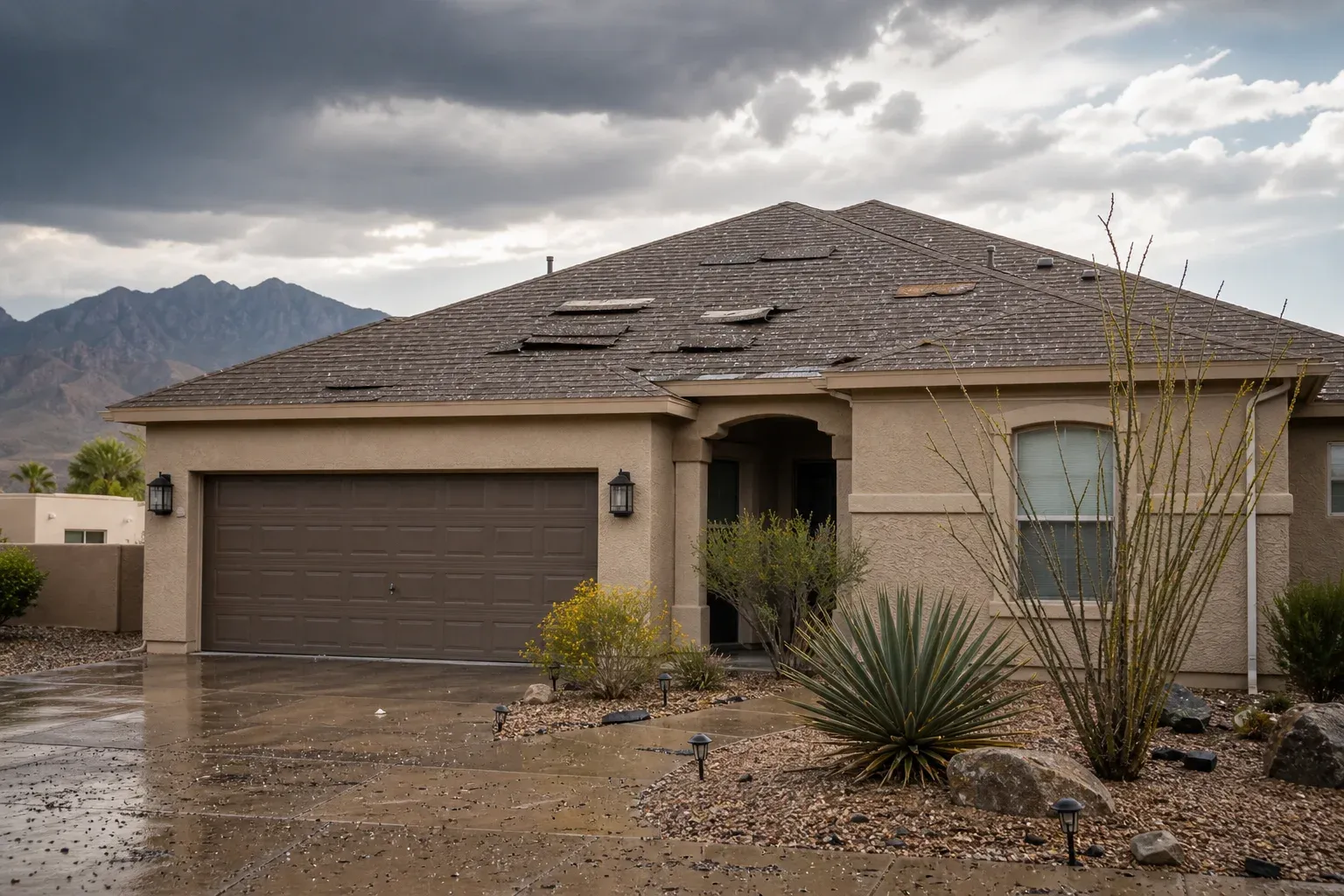
What Monsoon Season Can Do to Your Roof
Published June 20, 2026
The North American Monsoon is one of the most distinctive features of life in southern New Mexico. For most of the year Las Cruces is bone dry, but from roughly early July through mid-September the moisture patterns shift and afternoon thunderstorms become a near-daily possibility. Those storms are often fast and intense — hail, straight-line winds, and flash flooding can arrive and pass in under an hour, leaving real damage behind.
Here’s what to know about protecting your roof and handling any damage that results.
Why monsoon storms are hard on roofs
Hail
Hailstorms are the most common cause of sudden roof damage in the Las Cruces area during monsoon season. Even hail that seems small can knock protective granules off asphalt shingles, dent metal panels, crack tile, and damage flashing. You may not see a leak right away — granule loss accelerates UV wear and shortens the remaining life of the roof even without an immediate water intrusion.
Wind
Monsoon storms frequently produce strong, gusty winds. Lifted or torn shingles, displaced ridge caps, and damaged flashing are the most common results. A flat or low-slope roof with aging membrane can also develop separations or punctures from wind-driven debris.
Flash flooding and standing water
Las Cruces receives most of its annual rainfall in just two months. Flat and low-slope roofs (common on adobe-style and ranch homes throughout Doña Ana County) need functional drainage — scuppers, drains, and gutters — to handle intense short-duration rainfall. Clogged drainage combined with a heavy monsoon rain is a recipe for ponding water that can force its way through any weakness in the membrane or parapet flashing.
Haboob dust storms
While not monsoon events per se, dust storms (haboobs) occasionally precede monsoon activity in the Mesilla Valley. Fine particulate can work into minor gaps around flashing and vents. More practically, the high winds that generate dust storms can lift shingles and damage unsecured roof components.
What to check after a monsoon storm
After any significant storm passes, do a visual inspection from the ground before calling anyone:
- Look for shingles that are visibly missing, lifted at the corners, or displaced
- Check gutters and downspout areas for an unusually large accumulation of granules — this is a sign of significant hail impact
- Look along ridgelines and hips for displaced caps
- Check inside your home for any ceiling stains, wet spots, or attic moisture that weren’t there before
- On flat roofs, look for pooling water that hasn’t drained within 48 hours of the storm
Do not get on the roof yourself to inspect it — that’s what a roofing estimate is for.
Documenting damage for an insurance claim
If you suspect significant hail or wind damage, document it carefully before anything is repaired:
- Note the date and time of the storm. Weather data can corroborate the event.
- Take photos of any visible damage from the ground — lifted shingles, dented gutters, granule piles.
- Check whether neighboring homes or properties also show damage from the same event. Widespread neighborhood damage helps establish the storm as the cause.
- Call your insurer to report the damage and ask about your deductible and the claims process before authorizing repairs.
A roofer can meet your adjuster on-site and document the damage from the roof itself. We’re familiar with what adjusters look for on hail and wind claims in the Las Cruces area and can help make sure legitimate damage isn’t overlooked.
Monsoon season maintenance checklist
Before monsoon season arrives each July, it’s worth doing a quick check:
- Clear gutters and downspouts — any debris from spring winds can block drainage right when you need it most
- Inspect flat roof drains and scuppers — a blocked scupper during a monsoon rain can mean 3–4 inches of water on a flat roof in under an hour
- Check flashing around chimneys, vents, and parapet walls — these are the most common entry points for water
- Look for any cracked or missing caulk around penetrations — even a small gap can become a leak under driving rain
A pre-monsoon roof check takes a roofer about 30–45 minutes and can catch small problems before they become large ones.
When to call a roofer
Call for a professional estimate if:
- You see displaced, lifted, or missing shingles after a storm
- You have a flat or low-slope roof and water isn’t draining after 48 hours
- You see any new ceiling stains or attic moisture
- A neighbor with a similar roof had storm damage and yours is the same age
- You’re planning to file an insurance claim — having a roofer’s documentation makes the process much smoother
Call (575) 222-7950 for a free, no-pressure estimate after any storm. We’re local, we know what monsoon damage looks like in this area, and we can give you an honest assessment of what you’re dealing with.