
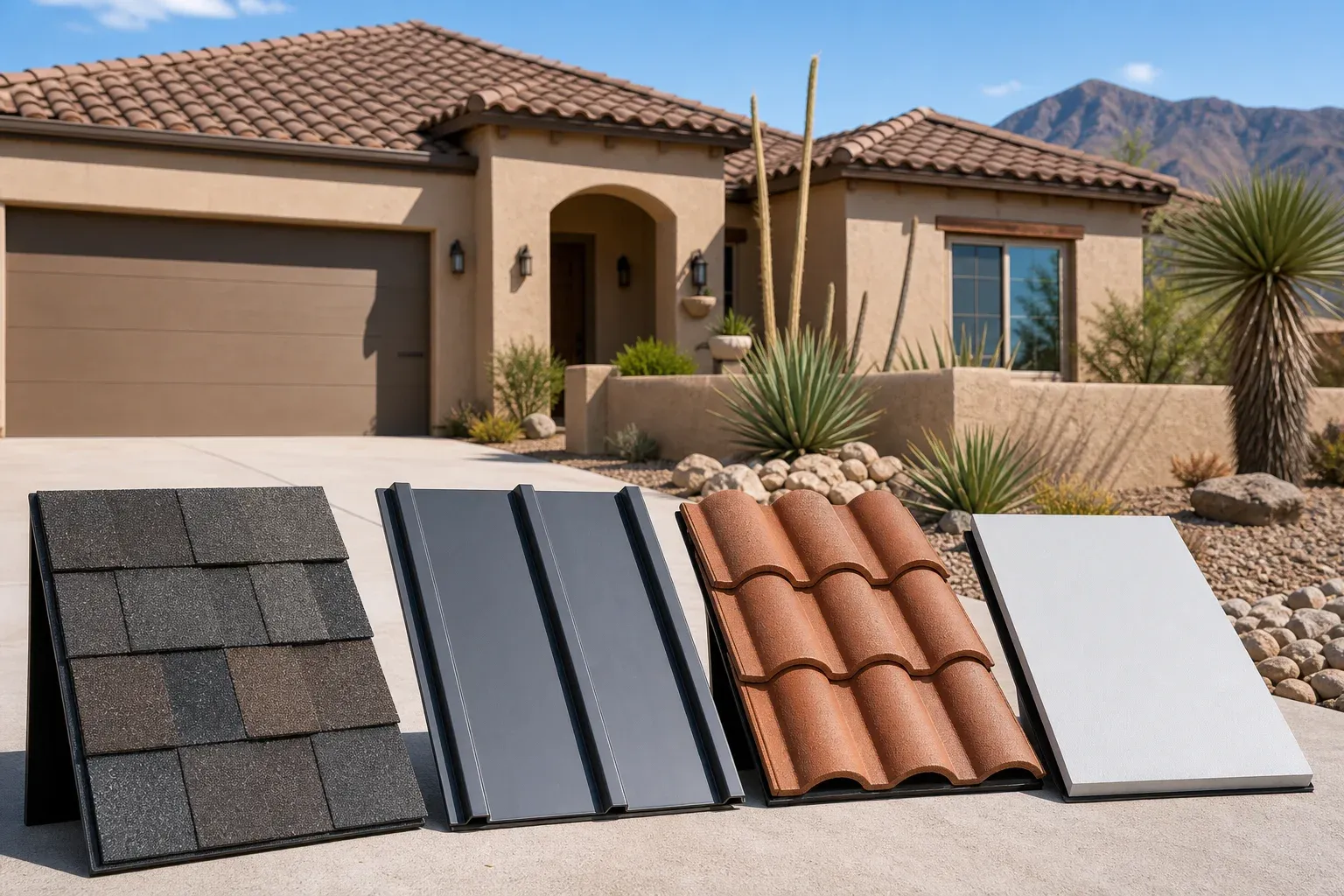
What's the Best Roofing Material for Our Desert Climate?
Published May 28, 2026
Las Cruces sits at about 3,900 feet elevation in the northern Chihuahuan Desert. That means intense UV radiation, summer temperatures regularly above 100°F, monsoon storms from July through September, and occasional hard freezes in winter. The right roofing material handles all of that — the wrong one wears out faster than it should. Here’s a practical comparison.
Asphalt shingles
Best for: budget-conscious homeowners with standard pitched roofs
Expected lifespan in Las Cruces: 15–20 years (shorter than rated lifespan due to UV and heat)
Asphalt shingles are the most widely installed roofing material in the country, and they work in Las Cruces — but the desert climate shortens their useful life compared to milder climates. The UV index in southern New Mexico is among the highest in the continental US, and it degrades the asphalt binder that holds granules in place. Heat also causes shingles to expand and contract through daily cycles, which stresses the adhesive strips over time.
If you’re choosing asphalt shingles for a Las Cruces home, architectural (dimensional) shingles are worth the modest extra cost over basic 3-tab. They’re thicker, better at resisting wind uplift, and carry longer warranties. Make sure adequate attic ventilation is part of the installation — poor ventilation dramatically accelerates asphalt shingle wear in hot climates.
Approximate installed cost: $5.00–$8.50/sq ft for architectural shingles
Metal roofing
Best for: homeowners prioritizing longevity, heat performance, and hail resistance
Expected lifespan: 40–70 years
Metal roofing is an excellent match for the New Mexico climate. It reflects solar radiation rather than absorbing it, handles hail well (most metal roofing carries Class 4 impact ratings), and doesn’t degrade from UV the way asphalt does. Standing seam metal — where the seams run vertically and clip together without exposed fasteners — is the premium option for a Las Cruces pitched roof. Corrugated and exposed-fastener panels are a more affordable metal option with slightly more maintenance requirements over time.
The higher upfront cost is the main objection to metal. But when you factor in that a metal roof often outlasts two asphalt roof replacements on the same home, the long-term math frequently favors metal for homeowners who plan to stay in the house.
Approximate installed cost: $8.50–$15.00/sq ft (standing seam)
Clay and Spanish tile
Best for: homes where appearance and long-term durability both matter
Expected lifespan: 50+ years
Clay tile is the traditional roofing material for Spanish Colonial and Mission-style architecture, which is common throughout the Las Cruces and Mesilla Valley area. It handles heat extremely well — the thermal mass of tile moderates temperature swings, and its inherent air gap above the deck provides natural ventilation. Clay tile is non-combustible and holds up well against hail.
The downsides: it’s heavy (structural support requirements should be verified before installing tile on a home not built for it), expensive, and brittle under foot traffic. Individual cracked tiles need prompt replacement to prevent water intrusion. Concrete tile is a lower-cost alternative with similar performance but heavier weight.
Approximate installed cost: $11.00–$22.00/sq ft (clay); $9.00–$16.00/sq ft (concrete)
Flat and low-slope membrane roofing
Best for: adobe-style, ranch, and contemporary homes with flat or low-slope rooflines
Expected lifespan: 15–25 years depending on material and maintenance
Flat and low-slope roofs are common across Las Cruces — they suit the Southwest architectural tradition and are practical for single-story construction. The right membrane choice matters:
- TPO (thermoplastic polyolefin): the most popular modern single-ply option. White TPO reflects heat well, which is valuable in the Las Cruces climate. Seams are heat-welded, which provides strong waterproofing when installed correctly.
- EPDM (ethylene propylene diene monomer): a rubber-based membrane that has been around for decades. Black EPDM absorbs heat (not ideal for Las Cruces summers unless coated), while white or coated versions perform better.
- Modified bitumen: a more traditional asphalt-based system that remains common in New Mexico. It performs reasonably well but doesn’t reflect heat as effectively as white TPO.
For any flat roof in Las Cruces, drainage design is critical. The monsoon season can dump over an inch of rain in an hour, and a flat roof without properly sized and clear drains and scuppers will pond — and ponding water is the main enemy of flat roof longevity.
Approximate installed cost: $5.50–$10.00/sq ft
Putting it together
| Material | Lifespan in NM | Heat performance | Hail resistance | Cost (installed/sq ft) |
|---|---|---|---|---|
| 3-tab asphalt | 12–17 years | Fair | Moderate | $3.50–$6.00 |
| Architectural shingles | 15–20 years | Fair–Good | Moderate–Good | $5.00–$8.50 |
| Standing seam metal | 40–70 years | Excellent | Excellent | $8.50–$15.00 |
| Clay tile | 50+ years | Excellent | Good | $11.00–$22.00 |
| Concrete tile | 40–50 years | Very good | Good | $9.00–$16.00 |
| Flat/TPO membrane | 15–25 years | Good (white) | Moderate | $5.50–$10.00 |
No material is right for every home. The best choice depends on your budget, roof pitch, home style, and how long you plan to stay in the house. Call (575) 222-7950 for a free estimate and honest conversation about what makes sense for your specific situation.